
Meet Ed Campbell: Digital Learning Specialist
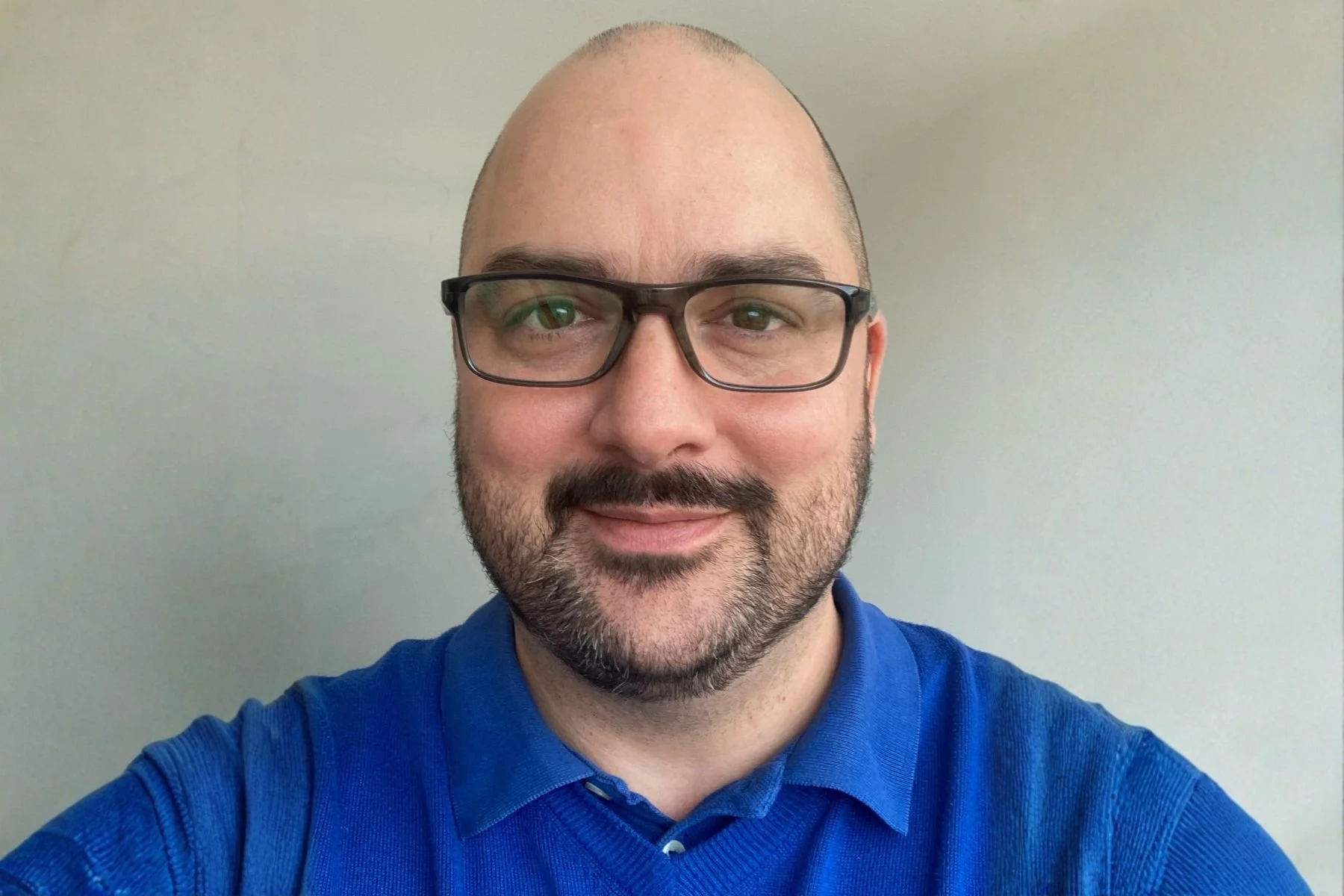
Could you introduce yourself first? Where are you from?
I am Ed Campbell, digital learning specialist who lives in Le Mans, Pays de la Loire, France. I run a small French association, Mtracs, that specialises in supporting mentors, trainers and researchers to strengthen their knowledge and practices. I often help scholars to create online courses or to repurpose their existing material so that it could be disseminated to a wide audience. I am originally from a small mining town in the far north of South Africa, but I spent most of my adult life studying and working in Stellenbosch and Cape Town, South Africa.
In which field did you complete your PhD?
Technically, educational sciences (sciences de l'éducation), with a strong higher education studies flavour. As with many PhDs, I built a framework that went beyond the discipline, containing concepts and ideas from sociology, linguistics, ethnography, the New Literacy Studies (NLS), multimodal semiotics, teacher education, and anthropology.
In which context (country, institution, lab)?
The School of Education (SoE), University of Cape Town (UCT), with co-supervision at the Centre for Higher Education Development (CHED) at UCT.
Why did you decide to pursue a PhD?
To be honest, I got an attractive scholarship to do a full-time PhD, whereas most PhD candidates in South Africa have to fund their own studies while working full-time in industry, or sometimes, as support or part-time teaching staff at a university in a position that has nothing to do with their PhD. In South Africa, a PhD is viewed as “studying on the side”, not a job. In 2016, I was struggling at my job due to health problems, so when I received the offer for full-time funding to study, which would have meant less physical and strenuous work on a daily basis, I left my job for a more viable option. By then, my husband just obtained his PhD too. I believe gay relationships work better with some semblance of equality.
What was your first step after completing your PhD?
I moved to Rouen, France, because after a horrific 2021 with lock-downs in South Africa, I was looking for an adventure. In December 2021, just after I graduated, I responded to a call for proposals by Volvo Research and Educational Foundations (VREF) and got it as an independent specialist. That project was renewed in 2023 and 2024. Apart from that, I spent most of 2022 and 2023 exploring France/Europe, writing new songs, poetry, blog articles and a horror novel - all things that I engaged in less while doing the PhD.
Did you have a clear career plan at that time?
Not really. En fait, pas du tout !
What were the main challenges you faced?
I think the challenges are only emerging now, five years after the PhD. I was lucky to get that first bit of funding right at the start of my “new career.” Importantly, I got that funding without being affiliated with a higher education institution, which almost never happens. So, perhaps the challenge involves gaining an erroneous impression of what life would be like as a freelancer after the PhD.
What is your current position and sector?
I am an autoentrepreneur who does freelance work as a digital learning specialist and sometimes editor in the higher education sector. The work that I do as the operations director at Mtracs coincides with this, with the added responsibility of occasional events co-ordination (seminars, small conferences, hopefully a writing retreat one day…).
How is your PhD useful in your current role?
It is not really. As a matter of fact, it is often a barrier because I am now overqualified for most of the activities in which I engage, which seems to matter more in Europe than where I come from. It is not all that bleak, there are some things that the PhD brought into my life that changed, even benefited it in some way, but these things are quite subtle and nuanced. I will see if I could explain this as I answer the follow-up questions.
Which PhD-developed skills do you use the most today?
Overthinking things and taking forever to make a decision. Again, not very useful. I know it sounds like I am not grateful for my PhD. I am. I am deeply thankful, it proved to me that I could finish something complex (mostly) on my own, during a time when the world lost focus completely (I did my writing up in 2020, while being “stuck” in Paris for six months without an opportunity for repatriation). I also got paid well for the PhD and it afforded me a six-month trip to Bremen, Germany, which I really enjoyed. If nothing else, the PhD introduced me to Europe and, although completely indirectly, France. I met many people that I would have never met if I did not do the PhD… but I guess you can say that about doing anything.
Have you experienced one or several career transitions?
Several. I have worked in more than 17 sectors as a professional, ranging from automation engineering and bookkeeping, wine tasting ambassador and recruitment advertisements, to work as teacher educator, learning designer, musician, composer and actor.
Were these transitions chosen or imposed?
I am not always sure. I am very good at convincing myself that something was actually my idea all along. Seriously though, I see everything as interlinked systems, so a “transition” is often just a case of understanding how one system is similar or different from another. Sometimes I would move between things that other people would describe as “different contexts” without noticing it. This way of looking at the world has its gains and losses, as you can imagine.
What was the most difficult aspect of these changes?
Well, I always see myself as an outsider. It is often difficult to engage in a community of practice, because who I am and what I do are so hard to explain. I also tend to speak in quite abstract, high-level, domainless, slightly over-philosophical terms that people often view as irrelevant or generic, which I guess is a product of my way of thinking and my career history thus far. But I am working on that (right now as I am typing this, in fact).
Looking back, would you do a PhD again? Why?
If I get paid to do it, yes, maybe. I am always open to anything. I do not even really care about the topic. My (first) PhD taught me to make anything interesting to me. It just makes life easier.
What would you say to a PhD candidate who is currently doubting?
I’d tell them to just finish it, which is a reward in self-confidence in itself. Confidence can change your life. The rest is a bonus.
What is your greatest achievement since completing your PhD?
Buying property in France and learning to read French philosophy in French, to be honest. Last year, I finished reading my first French book of more than 200 pages (it was on ethics in hospitals…), which was a big moment for me, because I find learning French an enormous challenge. Additionally, I wrote a handbook based on a course we ran for two years, of which I am quite proud. I think the PhD taught me not to be scared of mammoth-looking undertakings, from navigating the complicated bureaucracy of a certain foreign country and learning a language to which I’ve never been exposed, to applying for another Erasmus+ grant that I might not get. It taught me that things will eventually come together… although sometimes I think I might be pushing my luck a bit.
How do you envision the next steps of your career?
I am at the point where I realise that what I do might have an expiration date on it. I am in need of a long-term plan. I do not quite know the specifics, but I do know that certain ‘things’ will always be present in whatever I do, so the specifics do not really matter that much: learning, culture, place, writing, events, community and technology. I think at the moment I might need more contact with others, as a way of conducting “fieldwork” into what will come next. That being said, I am thinking of moving to Brittanny, perhaps Vannes, because Le Mans is lovely, but temporary. That would mean that I would have moved twice since moving to France, which is very un-French. As long as there is a direct TGV line to Paris, because both my husband and I have strong ties with the city.
What advice would you give to PhD holders in transition?
I assume you mean “transition to industry.” I am not sure I was ever really in academia - I only published one article - and all my teaching was part-time, while I was doing many other things that could be considered as “industry”, I guess. I am also not quite sure that I completely cut the rope, because most of my work has something to do with academic literacy or higher education and my clients are either funders or senior academics. I guess my advice would be to maintain your relationships within academia even if it seems like you are not quite in it anymore. That part of you that did the PhD will always be with you and, if conceived carefully, could always be an asset in some way or another. Sometimes in surprising ways. Lastly, that connection with the scholarly realm could still grant credibility - something that is in ever-increasing demand.
